When planning a professional fireworks display, safety distances are one of the most important factors we consider. These distances protect spectators, property, and our firing crew — and they also help ensure the display looks its best.
This post explains the minimum safety distances required for different categories of fireworks, how manufacturers set those distances, and why we apply additional safety margins for professional displays.
What Do We Mean by “Safety Distance”?
The safety distance refers to the minimum clear space between the spectator viewing area and the area where the fireworks are launched. This includes ground-based firing positions, and rocket launch points. No spectators, buildings, or vehicles should be within this zone, as it is designed to allow fireworks to perform safely and to contain any fallout or unexpected behaviour.
Firework Categories: F2 and F3
Fireworks sold and used in Northern Ireland are classified into categories based on their power, height, and intended use.
🎆 Category F2 – Small to Medium Fireworks
Designed for outdoor use in confined areas
Lower effect height and fallout range
Commonly used for small community events and private displays
Typical manufacturer safety distance:
8 metres (most F2 fireworks)
15 metres (larger F2 or smaller F3-style effects)
🎇 Category F3 – Large Display Fireworks
Intended for large open spaces
Higher break heights and wider fallout areas
Common in organised public displays
Typical manufacturer safety distance:
25 metres
Other Firework Categories (F1 & F4)
For completeness, F1 fireworks are very low-hazard items such as sparklers and small novelty fireworks, designed for use in very confined areas and typically requiring minimal safety distances. At the other end of the scale, F4 fireworks are professional-use-only fireworks with significantly higher power and complexity. (Think New Years Eve fireworks at Big Ben or Sydney Opera House!!)
Our Enhanced Safety Policy
While manufacturer distances represent the minimum requirements, professional display companies often increase these distances to add an extra margin of safety.
🔒 Our standard approach:
We apply a 1.5× safety multiplier to the manufacturer’s minimum distance
This reduces risk from wind shift, angled breaks, and unexpected behaviour
What this means in practice:
| Firework Type | Manufacturer Distance | Our Minimum Distance |
|---|---|---|
| F2 (small) | 8m | 12.5m |
| F2 / small F3 | 15m | 22.5m |
| F3 | 25m | 37.5m |
| Rockets | 25–30m | 50m minimum |
🚀 Rockets always require extra space due to their flight path and potential for drift — for this reason, we enforce a minimum 50m safety distance.
Why More Distance Is Better (Not Just Safer)
Interestingly, fireworks often look better when viewed from slightly further back:
Effects have more room to fully develop
Aerial bursts appear larger and more symmetrical
Spectators get a wider field of view
Noise levels are more comfortable
In short: safer distances usually create a better show.
Visualising Safety Distances
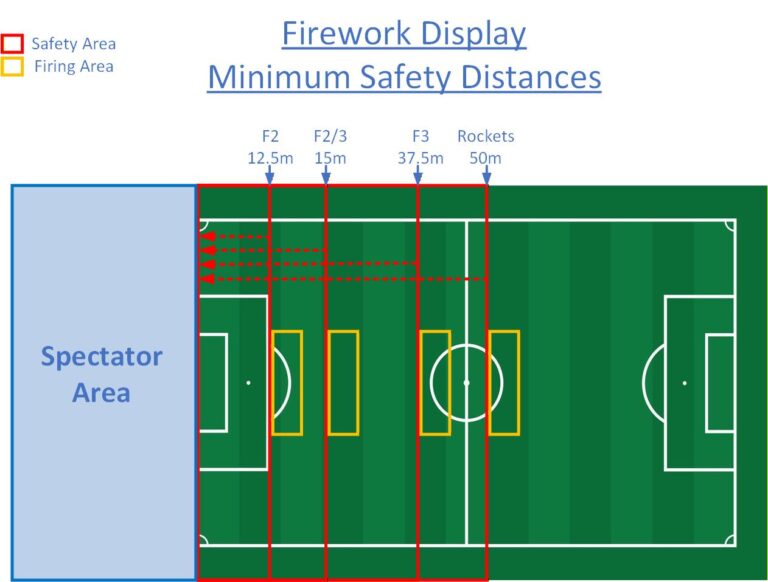
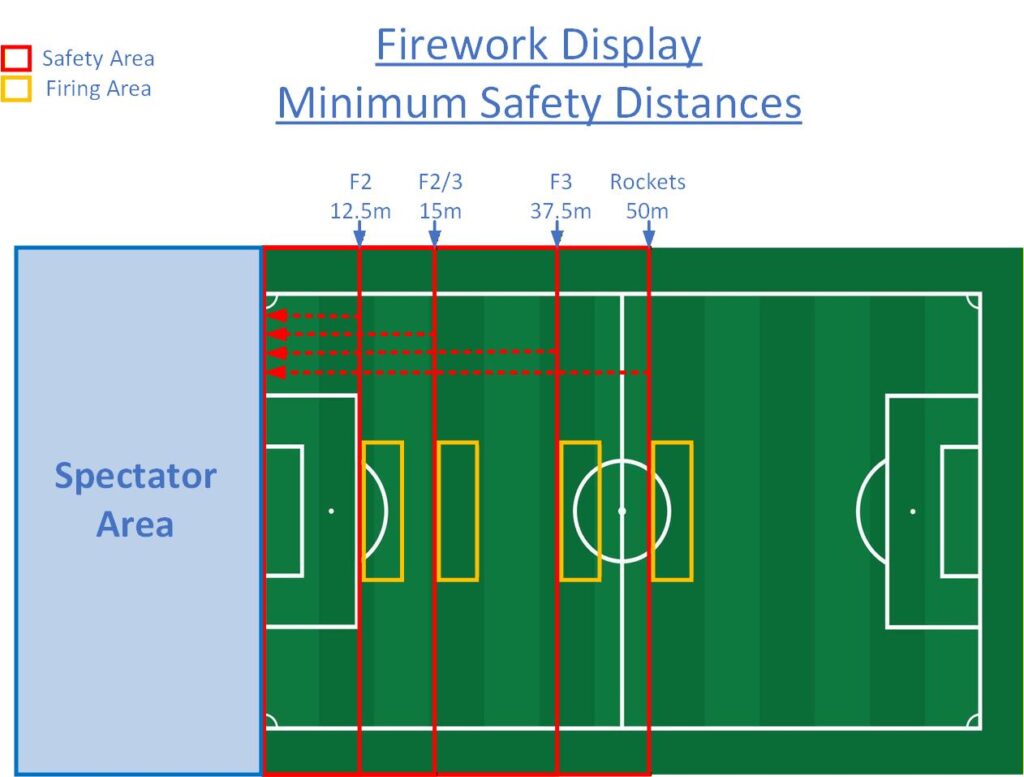
To help clients understand these distances, we often use a familiar reference point — a standard football pitch.
Example Layout:
Spectators positioned behind the goal
Firing points measured from the spectator line:
12.5m – small F2 fireworks
15m – larger F2 effects
37.5m – full F3 display fireworks
50m – rockets
This visual guide helps event organisers quickly see what size space is required for different types of displays.
What This Means for Your Event
When you book a fireworks display with us, we:
Assess the available space
Select fireworks that suit the venue safely
Apply enhanced safety distances as standard
Design the display so it looks spectacular from the viewing area
If you’re unsure whether your venue is suitable, we’re always happy to advise — safety first, spectacle always 🎆
If you’d like a site assessment or have questions about fireworks distances for your event, get in touch and we’ll be happy to help.